The short answer
To understand how to mow a steep hill safely, begin by deciding whether that hill should be mowed with your equipment at all. Measure the slope, follow the exact mower manufacturer’s instructions, inspect for water edges and drop-offs, and work only when the surface is firm and dry. Do not rely on how a hill looks from the bottom or on what a previous owner managed to do.
There is no universal angle that makes every mower safe. Stability changes with the machine, attachments, direction of travel, soil moisture, vegetation, hidden obstacles, turns, operator training, and the consequences of losing control. If those factors are uncertain, a professional evaluation is the safer next step.
How to mow a steep hill safely starts with measurement
Photos flatten terrain, and people often confuse degrees with percent grade. Percent grade is rise divided by horizontal run, multiplied by 100. A 45-degree slope equals a 100% grade—not a 45% grade.
You can estimate a uniform section with a level, a straight board, and a tape measure, or use a clinometer designed for slope measurement. Check several points because a yard may steepen near the top, curve sideways, or end at a ditch. The forthcoming ClearSlope measurement guide will explain the calculation in detail; until then, compare your measurement directly with the terminology used in the mower manual.
OSHA’s riding-mower guidance tells operators not to exceed the manufacturer’s stated slope limits and recommends a slope indicator when an angle must be determined. OSHA also notes that when instructions are unavailable or do not specify a limit, terrain still must be evaluated rather than assumed safe.
2. Read the manual for the exact mower and setup
“Riding mower,” “zero-turn,” “walk-behind,” and “slope mower” are broad categories. Two machines in the same category can have different limits and different instructions for slope travel. Attachments, collection systems, ballast, tire configuration, and deck position can also affect handling.
Use the manual for the exact model and configuration. Follow its warnings about maximum slope, travel direction, turning, braking, attachments, protective structures, and wet conditions. Never test a mower near a claimed maximum simply because another machine handled the property.
This is also why blanket advice to mow either across a slope or straight up and down can be misleading. The correct direction depends on the equipment manufacturer’s instructions and the site. A future article in this cluster will address that question without replacing the manual.
3. Inspect the full route on foot—from a safe position
Look for hazards before tall grass and machine vibration make them harder to see. If walking the face of the hill is questionable, inspect from the top, bottom, and accessible sides rather than stepping onto unstable ground.
- Rocks, stumps, wire, branches, holes, washouts, and animal burrows
- Wet spots, loose soil, sand, mud, leaves, and thick clippings
- Retaining walls, pond edges, creeks, culverts, ditches, and drop-offs
- Irrigation heads, utility boxes, guy wires, drainage pipes, and fences
- Blind transitions where the grade changes near the crest or toe
- People, pets, vehicles, windows, and other objects in the discharge area
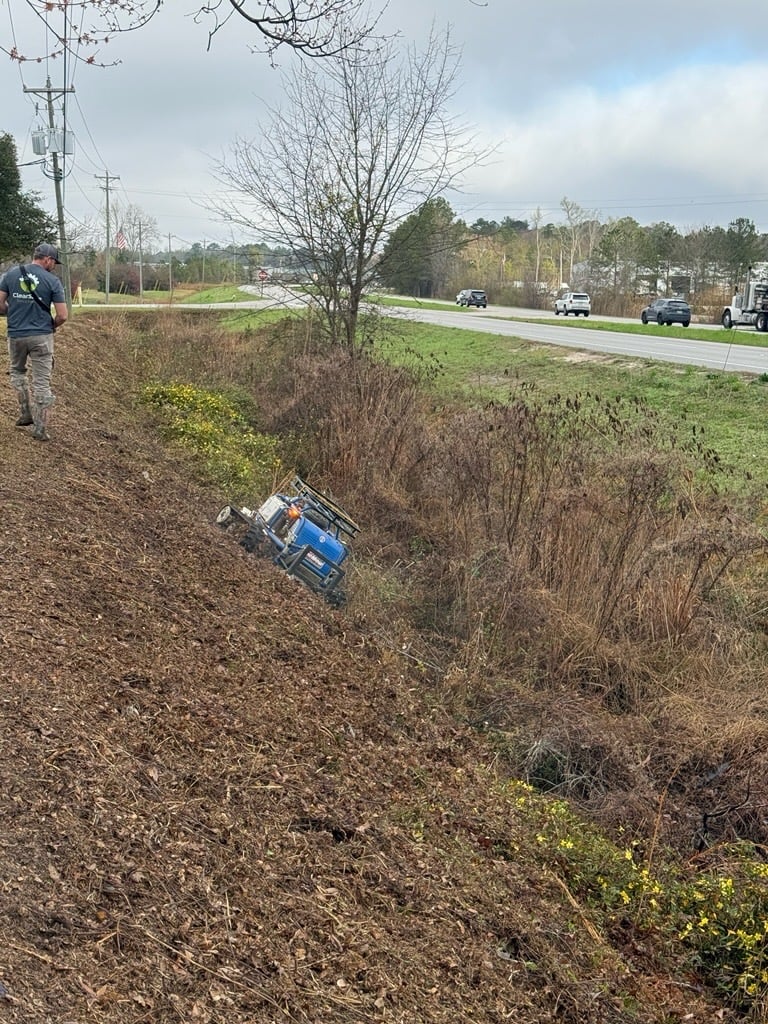
OSHA identifies wet surfaces, embankments, ditches, culverts, retaining walls, streams, ponds, and excavations as rollover hazards. Near these features, the consequences of sliding can be more important than the measured slope alone.
4. Wait for suitable ground and weather
Wet grass can reduce traction, while saturated soil may rut, shear, or give way under machine weight. Morning dew can matter even when it has not rained. So can damp leaves, loose pine straw, shade, and runoff emerging halfway down the hill.
If tires or tracks are slipping, the soil is deforming, or steering response changes, stop. Do not treat one successful pass as proof that the next pass will behave the same way. Work may need to be postponed until the vegetation dries and the soil firms.
Carolina hills can change quickly after summer storms and extended wet periods. That regional reality supports a simple rule: schedule around the site condition, not only the calendar.
5. Match the tool to the terrain
Suitable equipment may include a walk-behind mower for a small, manageable area, a conventional riding mower on terrain clearly within its limits, purpose-built slope equipment, or no mower at all. A planted groundcover or lower-maintenance vegetation plan may be the better long-term solution for some banks.
When ordinary equipment is not appropriate, professional remote-controlled mowing can reduce direct operator exposure because the trained operator controls the machine from a selected position rather than riding on the slope. It is actively operated—not an autonomous residential robot mower.
ClearSlope uses a TracMow 80 EVO tracked slope mower designed to handle suitable slopes up to 45 degrees, depending on access, soil, vegetation, obstacles, visibility, weather, and manufacturer requirements. That maximum capability is not a promise that every 45-degree property can or should be mowed. A site assessment determines suitability.
Learn more about ClearSlope’s remote-controlled mowing services and the broader principles in our guide to steep-slope vegetation management.
6. Know when to stop and call a specialist
Professional evaluation is appropriate when:
- The measured grade exceeds your mower’s instructions or is difficult to measure confidently.
- The machine slides, loses steering authority, lifts a wheel, or cannot stop predictably.
- The hill ends at water, a wall, roadway, culvert, ditch, or unprotected drop-off.
- Brush hides the ground or the area contains heavy stems, debris, rocks, or unknown obstacles.
- Access is narrow, gated, soft, or requires crossing another steep section.
- Conventional lawn companies decline the work because their equipment is not suited to it.
- The area is large enough that repeated manual cutting creates prolonged exposure and fatigue.
Declining unsafe or unsuitable work is responsible—not a failure by a lawn company. A slope-mowing specialist evaluates a different equipment category and can still decide to postpone or exclude areas when conditions are not acceptable.
A practical pre-mowing checklist
- Confirm the exact mower model, configuration, and manufacturer instructions.
- Measure the steepest relevant sections in the same units used by the manual.
- Inspect the route, crest, toe, turning areas, and possible runout.
- Identify water, walls, culverts, utilities, structures, people, and traffic.
- Check vegetation and soil moisture—not just the weather forecast.
- Remove manageable debris without entering unstable terrain.
- Choose equipment and direction only from manufacturer guidance and the site assessment.
- Stop if traction, steering, visibility, footing, or ground stability changes.
Conclusion: the safest method may be not mowing it yourself
Safe steep-hill mowing is a decision process, not a trick. Measure first, respect the specific machine’s limits, account for changing terrain, and avoid improvisation. When the hill, hazards, access, or vegetation exceed what ordinary equipment can manage, specialized remote-controlled mowing may reduce the need to put a person on the slope.
For an initial ClearSlope evaluation, send the property address, current photos, approximate area, access width, gates or fences, vegetation type, water or drop-off hazards, known rocks or stumps, and whether you need one-time clearing or recurring maintenance.
Steep-Hill Mowing FAQ
Short answers to common questions that should be resolved before mowing begins.
What angle is too steep to mow?
There is no universal safe angle for every mower. Use the exact manufacturer’s limit and instructions, then account for moisture, soil, vegetation, direction of travel, turns, obstacles, edges, operator training, and weather. A slope below a stated maximum can still be unsuitable.
Is it safe to mow a hill when the grass is only damp?
Damp vegetation can reduce traction even when the soil appears firm. Dew, shade, leaves, clippings, and recent rain can all change handling. Follow the mower manual and postpone work whenever traction or ground stability is uncertain.
Should I mow across a hill or up and down?
Follow the instructions for the exact mower. Travel-direction guidance differs by equipment type and configuration, and site hazards may make a normally recommended direction inappropriate. Do not rely on a universal rule from another mower or property.
Is a remote-controlled mower the same as a robot lawn mower?
No. ClearSlope’s mower is actively controlled by a trained operator using a remote control. The operator selects the route and responds to terrain and site conditions; the machine is not an autonomous residential lawn robot.
What should I send when requesting a steep-slope estimate?
Send the property address, several photos from safe viewpoints, approximate area, access width, gate or fence details, vegetation type, known obstacles, water or drop-offs, desired timing, and whether the need is one-time or recurring.