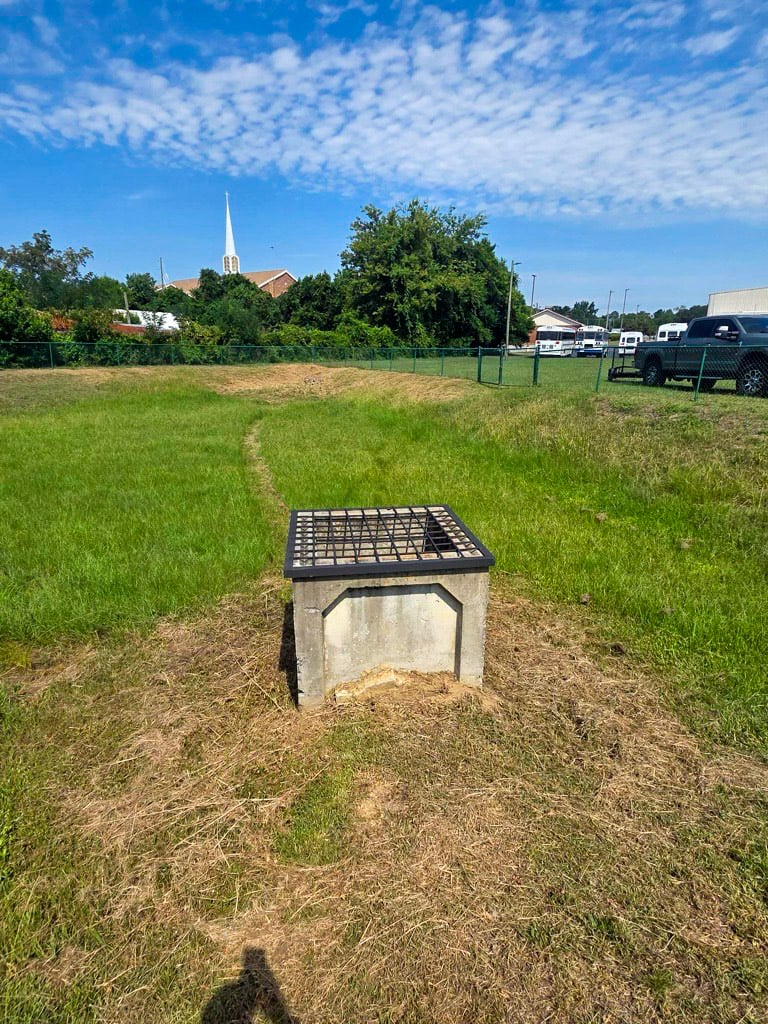
Planning a pond trash-rack installation starts with the outlet’s approved design, the reason for the work and a practical access plan. A contractor needs more than the width of the opening: the project must account for the existing structure, debris conditions, maintenance needs and any required professional or local review.
For an HOA or commercial property in North Carolina or South Carolina, preparation makes estimates easier to compare and reduces uncertainty before equipment arrives. The goal is a clearly defined installation—not an improvised change to how the pond stores or releases water.
Define the problem before selecting a product
Write a short description of why the project is being considered. For example: “The approved inspection report identifies a missing rack on outlet B,” or “The existing panel is displaced and we need a condition review.” Avoid starting with “install the strongest screen available” or “add finer mesh everywhere.” Those descriptions do not define the outlet’s needs.
NC DEQ’s design guidance says the anticipated debris problem should be analyzed when selecting debris protection. Upstream conditions and the type of facility matter. A screen that fits the opening is not necessarily a suitable screen for the drainage system. NC DEQ: Common SCM Structures and Materials.
Ask what must be verified before a firm scope can be provided. It is reasonable for an initial discussion to lead to a site review rather than an immediate product recommendation.
Gather the property and outlet documents
Prepare a small project packet rather than forwarding an unsorted collection of old emails. Include:
- The address and a marked site plan showing the exact structure.
- The relevant outlet detail or as-built drawing, if available.
- The operation-and-maintenance plan and applicable inspection findings.
- Photographs labeled with location and date.
- Known prior repairs, recurring symptoms and pending work.
- The owner’s authorized contact and the person responsible for maintenance.
Do not climb onto the structure or enter the basin to obtain measurements. Note missing information and let the site review establish how it can be obtained appropriately.
NC DEQ emphasizes site-specific maintenance agreements, access provisions and retained records. Those documents help distinguish the owner’s responsibilities from the contractor’s immediate installation scope. NC DEQ: SCM Operation and Maintenance.
Plan access without assuming every route is usable
Show the proposed meeting point, parking location, gates and route to the outlet. Tell the contractor about deliveries, resident activity, school schedules or other restrictions that could affect the visit. Identify known utilities, irrigation, landscaping and surfaces that need protection; share records rather than making assumptions about underground conditions.
Ask who will evaluate whether equipment access is suitable, what vegetation work is necessary, and how the route will be left afterward. A route that looks open in a photograph may still have soft ground, a steep bank or an ownership restriction.
Keep permission and practicality separate. An accessible route does not necessarily authorize crossing a neighboring parcel, opening a locked area or disturbing a planted buffer. Confirm these questions before scheduling work.
Ask for a scope that makes the responsibilities clear
Use these questions when discussing the proposal:
- Assessment: What conditions are being checked, and what requires another specialist?
- Design basis: Which drawing, specification or approved detail will guide the installation?
- Preparation: Is access clearing included, and what vegetation must remain?
- Installation: Does the price include removal of the existing assembly and installation of the specified replacement?
- Separate work: What happens if the supporting structure or attachment area needs attention?
- Closeout: What photos, product information, cleanup and maintenance instructions are included?
Clarify exclusions in writing. Screen installation should not silently expand into pipe work, concrete reconstruction, pond draining or changes to outlet elevations. If a separate issue is discovered, pause that part of the work until the owner and appropriate professional agree on the next step.
Confirm approvals and inspection roles
Check the requirements for the actual property before changing a drainage component. Lexington County’s published pond agreement is a local example of owner duties concerning inlet and outlet protection, but the project’s recorded documents and current authority determine what applies. Lexington County: Pond Maintenance Agreement.
Also separate installation from required inspection or acceptance. Raleigh’s stormwater reporting process, for example, identifies professional reporting requirements and exceptions for certain smaller sites. Do not treat that example as a statewide rule or assume an installation invoice satisfies your property’s reporting duties. City of Raleigh: Stormwater Device Inspection Reports.
Before approving the proposal, identify who answers design questions, who authorizes changes and who provides any required completion documentation.
Include maintenance in the handoff
A new screen still needs attention. Clemson Extension identifies keeping inlets and outlets clear as an ongoing pond-management task and encourages the community to keep yard debris out of storm drains. Installation does not eliminate that responsibility. Clemson: Stormwater Pond Owners & Managers.
File the completed project record where a future property manager can find it. Record the maintenance contact, agreed follow-up, and unresolved items. If vegetation work is coordinated with the installation, document its limits so later crews do not expand clearing into areas meant to remain planted.
Request a site-specific installation discussion
ClearSlope offers trash-rack and debris-screen installation and can coordinate vegetation access during project planning. Request a free estimate with your project packet and site photos. The assessment will help establish the practical scope; specialized design, regulatory review and certified inspection needs must be addressed separately when applicable.
Learn more in our trash-rack property manager’s guide and the Knowledge Center.
Pond Trash Rack Installation FAQ
What information is needed for a pond trash-rack installation estimate?
Start with the address, exact outlet location, available plans, safe-distance photographs, the reason for the work and access restrictions. The contractor can then identify what still needs to be verified during a site review.
Can an outlet screen be sized from the concrete opening alone?
No. Physical fit is only one consideration. The outlet’s intended operation, expected debris, attachment conditions and future maintenance access also matter. Use the approved design and obtain qualified design input when needed.
Do we need approval before installing or changing a trash rack?
That depends on the property, existing approvals and proposed work. Ask the responsible stormwater authority or design professional whether the work is maintenance under the approved plan or a change requiring further review. Do not assume it is exempt.
Should the new screen have smaller openings to catch more debris?
Smaller openings are not automatically better. Screen geometry affects debris capture, clogging and flow. A qualified reviewer should determine what suits the outlet; adding mesh to an existing rack without review can create another obstruction.
Can mowing be included with a debris-screen project?
It can be discussed as a separate part of the scope when vegetation limits visibility or access. Specify what should be cut, what vegetation must remain, how debris will be handled and any restrictions imposed by the approved plan.
What should the owner receive when installation is complete?
Request the installation location and date, photographs, relevant product or drawing information, agreed maintenance instructions and any unresolved issues. Confirm separately whether an inspection or acceptance document is required and who will provide it.
Sources and further reading
- NC DEQ: Common SCM Structures and Materials
- NC DEQ: SCM Operation and Maintenance Manual Chapter
- Lexington County: Pond Maintenance Agreement
- City of Raleigh: Submit a Stormwater Device Inspection Report
- Clemson Extension: Stormwater Pond Owners & Managers
Research reviewed September 8, 2026. This planning guide is not an engineered design, permit determination or certification of stormwater performance.
This guide provides general property-planning information. Site conditions, approved plans, manufacturer instructions, and applicable local requirements determine the appropriate scope. It is not a substitute for project-specific engineering or required inspections.