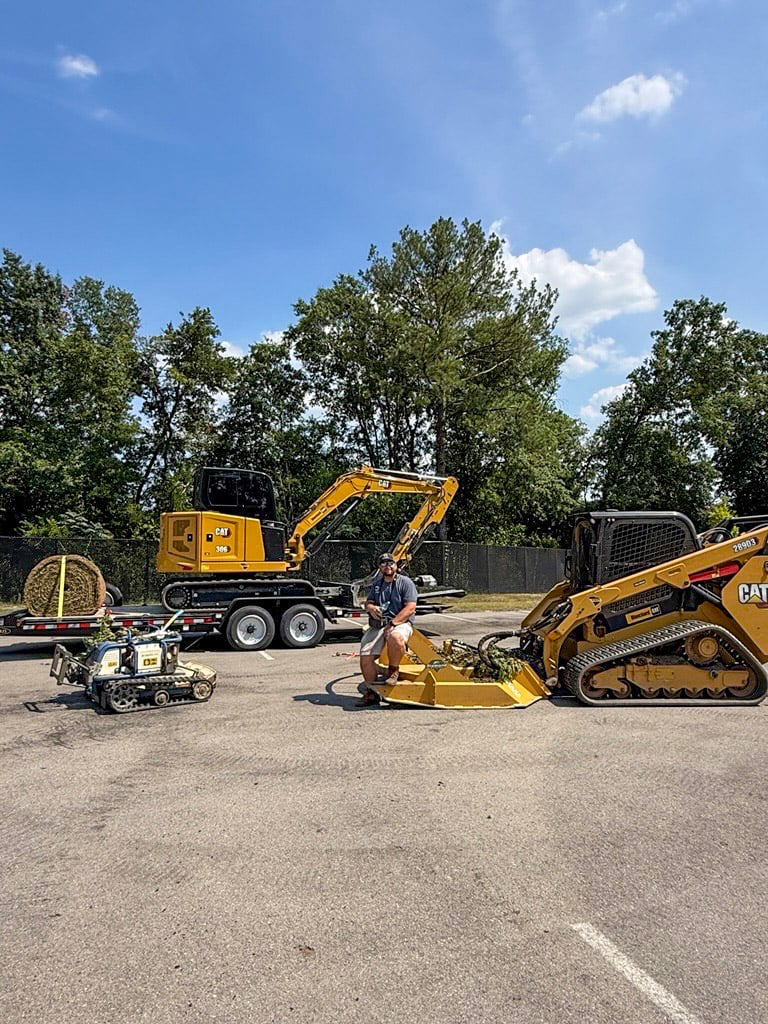
After forestry mulching, plan for three things: inspect the ground and remaining residue, monitor what grows back and establish the cover needed for the property’s next use. Mulching changes existing vegetation, but it does not guarantee permanent brush control or create a ready-made lawn. The follow-up plan determines whether the initial work remains useful.
A woodland edge, an access route and a future landscaped area need different follow-up decisions after treatment.
Why does vegetation return?
Some plants can regenerate from surviving below-ground parts, while new seedlings can appear from seeds already present or arriving later. Removing visible top growth does not necessarily eliminate those sources. Before deciding that every new shoot is a problem, identify what is growing and whether it belongs in the intended plant community.
The U.S. Forest Service’s masticated-fuels research found that regrowth differed by shrub growth habit and that mastication did not universally suppress seedlings. Those studies were conducted in western forests; their species and timelines should not be transferred directly to a Carolina property. They do reinforce why a one-pass, permanent-eradication promise is unreliable.
Start with a post-work walk-through
Once the contractor confirms the area is safe to enter, review the treated zones together. Look at access routes, retained trees, exposed soil, drainage features and any remaining stems or coarse pieces. Compare the work against the agreed scope rather than an assumption that every surface should resemble finished turf.
- Document the finish: photograph the same viewpoints used before treatment.
- Record exclusions: keep track of wet ground, protected areas or material left for separate work.
- Check the next-use areas: note where walking, planting or routine mowing is actually planned.
- Assign follow-up: identify who will inspect regrowth and address any required stabilization.
Do not drive a lawn mower across newly treated ground until obstacles, remaining woody material and the surface have been assessed. A cleared appearance does not establish that the area is suitable for ordinary mowing equipment.
Monitor plants before choosing the next treatment
Create a simple record with photos, locations and dates. Revisit the same spots during active growth and after conditions that warrant checking the site. Distinguish isolated sprouts from an expanding patch, and note whether desirable ground cover is filling in or being crowded out.
NC State Extension’s weed-identification guidance emphasizes identifying plants and keeping scouting records. It also explains that mowing effectiveness varies and that equipment can move seeds. For an invasive infestation, ask how equipment hygiene, timing and follow-up will be handled rather than relying only on the appearance immediately after cutting.
The U.S. Forest Service’s guide to southern invasive plants places monitoring and rehabilitation within the management process. Where herbicides are considered, obtain species-specific advice from Extension or a qualified applicator and follow the product label and site restrictions. This is not a recommendation to broadcast-treat a newly mulched property, nor a claim that chemical treatment is included in ClearSlope’s services.
Choose the ground cover for the intended use
A maintained open area
If the goal is a lawn, field edge or regularly cut access strip, discuss the surface needed for that use. A forestry-mulching finish may retain wood fragments, stems and roots that do not belong in a lawn seedbed. Converting that area is a separate planning step.
Clemson Extension’s lawn-establishment guidance treats species selection, soil preparation, planting and establishment care as connected tasks. That is why simply spreading grass seed over coarse residue is not a complete conversion plan. Match the planting choice to light, local growing conditions and the owner’s ability to maintain it.
A selectively managed woodland
If the goal is visibility and access under retained trees, a carpet-like lawn may be unnecessary. Clarify which routes need regular attention and which areas can support suitable understory. Keeping that distinction avoids paying to repeatedly cut vegetation that does not conflict with the project’s purpose.
A future improvement project
For future pavers, a driveway, a building or other hardscape, coordinate the next phase with the appropriate designer or contractor. Organic residue and remaining roots are not a constructed base. Do not mistake brush treatment for grading, compaction testing or foundation preparation.
Use soil information instead of guessing
Where planting is planned, test the soil for the intended plants and follow the resulting recommendations. Clemson Extension explains that soil testing guides fertilizer and lime decisions. Automatically adding lime or fertilizer after clearing can be unnecessary and may create nutrient imbalances.
Planting can be phased. Preparing the intended open area carefully while managing a woodland edge differently may be more practical than giving the entire parcel the same finish.
Watch ground cover and water movement
After rain, observe the site from stable, accessible locations. Look for new channels, sediment collecting downslope, displaced residue or water concentrating where it did not before. Do not enter flowing water, unstable banks or drainage structures to investigate.
NC State Extension’s erosion-control mulch guidance shows that material selection and application are tied to site conditions and vegetation establishment. Forestry residue should not automatically be treated as a designed erosion-control system. Bare patches or concentrated runoff may need a separate stabilization plan; significant erosion or drainage concerns warrant qualified review.
Keep the maintenance plan proportionate
There is no single follow-up calendar for every Carolina property. Start with the agreed purpose, inspect the actual response and adjust the scope. Early attention to a small unwanted patch may be more manageable than waiting until it obscures the area again, but the appropriate treatment still depends on the species and site.
For the initial method choice, compare forestry mulching and bush hogging. To plan your own project, review ClearSlope’s land-clearing services and request a free estimate that explains both the current growth and the result you want to maintain.
After Forestry Mulching FAQ
Will brush grow back after forestry mulching?
It can. Some plants resprout from surviving roots or stems, and seeds can germinate after treatment. The species present, growing conditions and follow-up work determine the response. Mulching should not be sold as guaranteed permanent vegetation eradication.
How long does forestry mulch take to break down?
There is no dependable universal timeline. Piece size, depth, wood characteristics, moisture and site conditions vary. Discuss the residue with the contractor and plan the next use around the actual surface rather than a promised decomposition date.
Can I plant grass immediately after forestry mulching?
Not automatically. A future lawn needs a suitable seedbed or sod surface, adapted turf and establishment care. The remaining residue and stumps may require separate preparation. Have the planting area assessed instead of broadcasting seed over all the wood debris.
Should I remove all the mulch?
Not as a default. Decide based on the intended use, existing cover, drainage and the actual residue. Leaving material, redistributing it or preparing selected planting areas are different scopes. Removal should not expose vulnerable soil without an appropriate stabilization plan.
How often should regrowth be cut?
Set the interval from the plants and the management objective, not a universal monthly schedule. Inspect during active growth and intervene before unwanted vegetation becomes difficult to manage. Some invasive plants need a species-specific strategy beyond repeated mowing.
Is forestry mulching enough to control erosion?
No treatment should be assumed to solve erosion by itself. Residue may provide some surface cover, but bare patches, concentrated runoff, unstable soil or damaged drainage can need a separate stabilization or repair plan and qualified professional review.
Authoritative resources
U.S. Forest Service: Masticated Fuels Research NC State Extension: Weed Identification in Pastures, Hayfields and Sprayfields U.S. Forest Service: Nonnative Invasive Plants of Southern Forests Clemson Extension: Lawn Establishment Clemson Extension: Soil Testing NC State Extension: Mulch Options for Erosion Control on Construction SitesExplore more property-care guidance in the ClearSlope Knowledge Center.
This guide provides general property-planning information. Site conditions, approved plans, manufacturer instructions, and applicable local requirements determine the appropriate scope. It is not a substitute for project-specific engineering or required inspections.